
But not both.
¿por qué no los dos?

A few months ago, I was at a beer festival talking with some people I had just met. At one point, one of the men in the group stated that he thinks it’s shameful when women post “provocative” beer photos on social media. Provocative is in quotes because it doesn’t take much for a woman who is simply existing to be denigrated based on her appearance.
Another woman in the group and I made eye contact after his comment. This is not the first time someone has said something like this to me, but I am still surprised when it happens. I guess I shouldn’t be, but every time I think “…we’re still saying things like this? To women? About women?”
When we both pushed back about that statement, he doubled down. More than doubled down, actually. He said that it is downright wrong for women to do that.
Weow, sir. First of all, no woman anywhere cares about any man’s sweeping statements on how all women should behave. Second, you’re really going to double down without a hint of irony? You think it’s shameful, yet you follow many of those accounts. Seems like if you really thought women with bodies (as in, all women) who may be holding a beer with some skin exposed or posed in a sexy manner were shameful and wrong, then you wouldn’t be following them.
We all know what’s really going on here, and it rhymes with schmatriarchy. I am also aware that this is not a new conversation or a novel topic. But if I still have to hear men complain about women acknowledging their sexuality - and possibly making money from it - then we need to keep having this conversation.
Additionally, I would be remiss not to acknowledge that this particular conversation about women and beer on social media is centered almost wholly around white women, who have been held up in our Eurocolonial society as the definition of beauty, particularly thin, able-bodied, white women. People who do not fall into those categories have a host of intersectional issues that also significantly impact how society views and treats them. Social media is no exception, especially with the anonymity that comes from being behind a keyboard.
The Madonna-Whore Complex has been written about extensively. Briefly, this phenomenon presumes that all women fit into one of two categories as perceived by (white, Eurocolonial) men - the women who can be admired (Madonnas) and the women who can be sexually attractive (Whores). The women categorized as sexually attractive are then devalued by men. As a woman, you can be one or the other.
But not both.
Thus, when a woman decides to take control of her body and her talents, as well as the way they are marketed and potentially monetized, this sovereignty makes society - especially men - furious. A woman who exercises sexual agency represents a threat to the social dominance of men.
In short: We have decided as a culture that there is almost nothing worse than a woman who wants attention.
From a young age, women are taught that their attractiveness is their currency. You learn that you are supposed to perform beauty labor to build that wealth.
However, that labor is only valuable when it is unpaid. If you start to profit from your beauty labor, you are frivolous and vapid. We’ve been taught that being pretty is the most valuable fiat money for a woman, so we also learn that the level of our attractiveness determines how society will treat us. If you can contort yourself into an acceptable societal beauty ideal, then you can rightly assume you will be treated better and have a better quality of life.1
Further, in our Eurocolonial society, we are taught that it is a sanctioned right of all men to sexualize all women, regardless of their age and status. Because of this, few women can completely avoid sexually objectifying experiences.
One of my roles in a former job was to send beer out to influencers. To facilitate this, I joined a Facebook group for beer enthusiasts, which was run by one of the regional influencers to whom I sent beer. I had chosen this person in part because he ran this Facebook group. I found this group to be refreshingly upbeat, made up of people who not only genuinely enjoyed beer but also seemed to celebrate others’ enjoyment of beer.
I’m betting a lot of us at one time belonged to a social media beer enthusiast group that devolved into mostly toxic grandstanding and chest thumping about “whales” while denigrating newcomers who wanted to post about how much they enjoyed their first Hopslam: “DoN’T yOu meAn HYpEsLaM?” This group was decidedly not that.
Until one day, the influencer/group administrator posted a meme featuring Jeff Foxworthy that said something along the lines of “If your beer pictures are of your boobs and you don’t know shit about beer, you might be a beer influencer.” 🫥
Again, maybe I shouldn’t have been surprised to see that this person posted a meme like that in a group like this, but I was. It was such a positive place for beer lovers, I thought. As it turns out, that is not true if you are a woman who dares to acknowledge both her love of beer and her sexuality in the same photo.
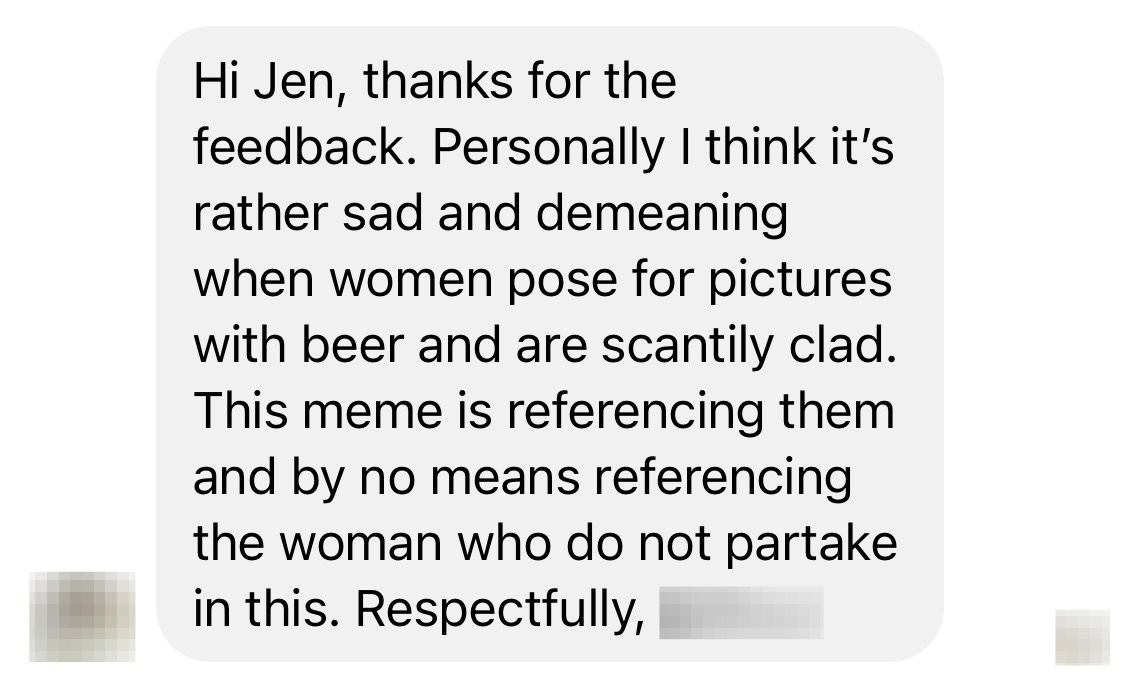
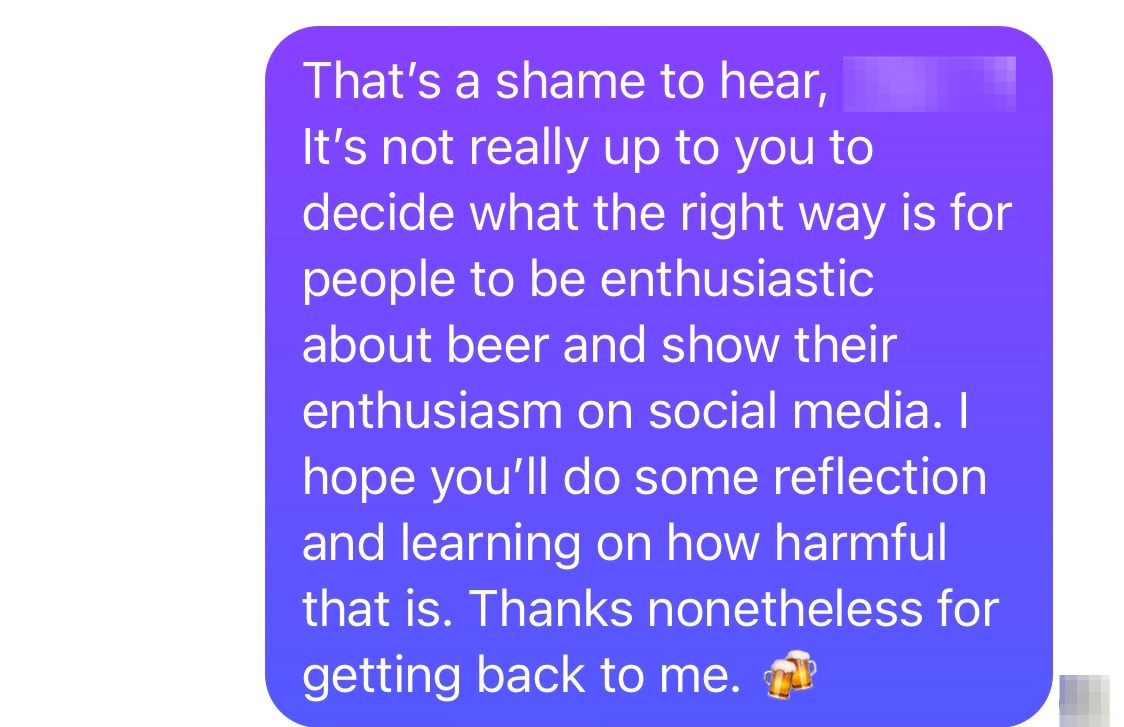
I DMed him to express how harmful memes like that are and ask that he take the post down.
His response:
My response:
It’s hard for me to convey the feelings that arise when this happens accurately. First, I’m surprised when it comes from someone I know. Not that I am the arbiter of detecting misogyny, but I also can’t assume every man I meet is just waiting for his chance to show his deep-seated hatred for women, whether conscious or unconscious. That’s not a healthy way to live, nor is it true. On the other hand, I’m also not quiet about these issues, so maybe I take it for granted that someone befriending me implicitly means that we have similar outlooks on things like, I don’t know, not being a sexist dick.
Second, I’m disappointed. Deeply disappointed. It makes it hard to trust the men around me, the people I consider friends and colleagues. How long until they reveal similar sentiments? Are all of them going to demonstrate that, actually, they do hate women, especially women who have taken control of their sexuality for their own means?
Third, it makes me feel unsafe. It creates instability in my personal and professional relationships. Is the guy wearing the “Antisexist, Antiracist, Proequality Beer Club” shirt with whom I just had a great conversation going to go online later to say violently misogynistic things to a woman posting photos of herself holding a beer while in a bikini?2 Is every guy a closeted, disgusted Pygmalion, smiling and making conversation with me while his internal dialogue is calling me a dumb bitch? These rhetorical questions are not hyperbolic - they are real safety concerns with which women have to grapple.3
Where do we go from here? These are socially ingrained ideas and behaviors, which means that there is no easy fix. Unlearning and extricating harmful patriarchal messaging takes time, and the process is not comfortable.
As with all cognitive biases, becoming aware of your bias is the first step. Pay attention to when you react to a woman who has sexual agency and interrogate that reaction: Why am I feeling this way? Is there evidence to support my beliefs? Am I holding onto beliefs that may no longer be valid?
Look for perspectives that are different from yours. This newsletter may be an entry point for you, but it is only that. There are far more diverse perspectives out there from far more knowledgeable people. Some of my favorite feminist newsletters include Roxanne Gay’s The Audacity, Lyz Lenz’s Men Yell at Me, and Amanda Montei’s Mad Woman and Dire Straights.4
Lastly, be willing to reflect on your actions and beliefs with a growth mindset. We all have biases that we need to unlearn. It’s okay to start somewhere and be open to feedback. When you can do this, people will support your unlearning and learning.
Humoral Medicine Never Left Us
I have a special interest in how remnants of humoral medicine persist in our lives. If you are not familiar with humoral medicine, it is the foundation of medicine and states that all illness stems from an imbalance in one’s humors. There are four humors: blood,5 yellow bile, black bile, and phlegm. In the beginning, the humors were linked with the four “elements” of air (blood), fire (yellow bile), earth (black bile), and water (phlegm). Each category of humors eventually expanded to correspond to a time of day, color, taste, patron planet, and astrological signs, among others. Treatment in humoral medicine often involved food and lifestyle changes.
Each humor was some combination of warm, cold, moist, and dry. For example, blood was considered warm and moist, while black bile was considered cold and dry. If your humors were out of balance, you brought them into balance by essentially using the opposite humors. Have too much black bile? Avoid food and drink considered cold and dry; instead, consume warm and moist food and drink. Beer, for example, was considered warm and moist, whereas vinegar was considered warm and dry.
“Beer” in many of these contexts was actually more like gruit in that it was heavily spiced both for medicinal and preservative purposes. Of course, the spices used needed to be considered “warm,” lest their addition to the beer render it useless for treating black bile.
Which brings us to our present setting - the holidays. Three spices that are particularly prominent during the Eurocolonial holiday season are cinnamon, ginger, and nutmeg. All three are commonly described as “warming” spices, a holdover from humoral medicine.
An interesting thing about humoral medicine is that, while some of it is appallingly terrible (you’ve got ghosts in your blood, we need to drain it all out!), much of it is intuitive and, in some cases, still applicable. Humoral medicine prescribed walking after meals, washing your hands, and getting rest.
This holds true in the case of our warming spices - cinnamon, ginger, and nutmeg. In the case of cinnamon and ginger, they literally are warming. Well, they are *kind of* literally warming. Cinnamon contains cinnamaldehyde, which triggers our trigeminal sense in much the same way menthol or capsaicin heat does. That is, cinnamaldehyde triggers the same pathways that perceive warmth. Ginger has a similar effect, only its “heat” comes from gingerol.
Cinnamon also helps decrease your blood glucose levels, which means it can help stop your blood sugar from spiking after a meal. Besides being a digestive aid, cinnamon also has antibacterial properties. Ginger, specifically gingerol, is a well-known digestive and anti-nausea aid. In the Middle Ages, ginger was used to mask the taste of preserved meats, which were mainly consumed during the winter months. Like cinnamon, nutmeg decreases your blood glucose levels and also increases serum insulin.6 Nutmeg also has antioxidant, antimicrobial, and insecticidal properties, which came in handy during the Bubonic Plague to keep plague-carrying fleas off of people wearing nutmeg necklaces.
Now you are well-armed with a “well, actually” story about winter warming spices to dazzle and/or annoy your loved ones during this holiday season.
And finally…
Before we leave each other, here are a few more things I am up to these days:
Creating a 2025 Holiday Book Guide for Sensory Lovers in my bookshop.org shop.7 The list contains about a dozen books that I have found to be beneficial in learning more about sensory.
Listening to The Storyteller by Dave Grohl. Nirvana has remained one of my very favorite bands. I highly recommend this book. Dave is genuine, hilarious, and honest. I love hearing stories from people I idolize about them meeting people they idolize. Rock legends, they’re just like us!
Reading Smelling to Survive: The Amazing World of Our Sense of Smell by Bill S. Hansson. This book is a lot of fun. It focuses on how other animals and even plants use smell to navigate the world. Because of this book, I’m adding “being able to smell underwater like a fish” to my wish list because UNDERWATER HAS A SMELL AND SOME FISH HAVE TWO NOSES!
This is not an assumption - pretty privilege has been fairly well researched and reported on.
The absolutely most bizarre insult I have seen my influencer friends get was a guy telling my friend that her pH looked off. Like, what?
For more on this, I recommend Men Who Hate Women: The Truth about Extreme Misogyny and How It Affects Us All by Laura Bates.
I do have gift subscriptions available to share for most of these newsletters. If you would like one, just respond to this newsletter and let me know which newsletter you’d like a gift subscription to.
Somewhat confusingly, “blood” in humoral medicine does not refer to the literal blood in our veins. Humoral “blood” is produced in the liver.
Nutmeg was also considered an abortifacient, i.e., it causes abortion. It is now considered ineffective as an abortifacient, although premature labor and miscarriage can occur if nutmeg is consumed in large amounts. Apparently, nutmeg also has hallucinogenic qualities - who knew?
By the by, juniper berry is a well-known emmenagogue; that is, it “brings menses” for those who need their menses to start happening again.
I do receive a small (10%?) commission for books you buy through my shop. Give your money to small fries like independent book shops (and me) and not to Jeffrey Preston Bezos.
Thanks for a very interesting and thought-provoking post. I struggle with the term 'influencer' (although apparently I'm on several breweries' lists as one) but I've never really examined my thoughts about 'provocative' imagery. It's always good to get a reminder to check one's own head.